

Gauteng vs Western Cape: How Digital Marketing Strategy Differs by Region


Same country, same industry, but a completely different digital game. That is the reality most South African businesses discover the hard way when they try to run one marketing strategy across both Gauteng and the Western Cape.
Both of the above-mentioned South African states run on different economic rhythms, different customer habits, and different competitive pressures. This means a marketing strategy built for one rarely transfers cleanly to the other.
This article breaks down exactly where the marketing differences between the two show up. From local SEO to paid ads, you will see what it means for how you should actually spend your marketing budget, depending on where your business operates.

Why One Marketing Strategy Doesn't Fit Both Regions
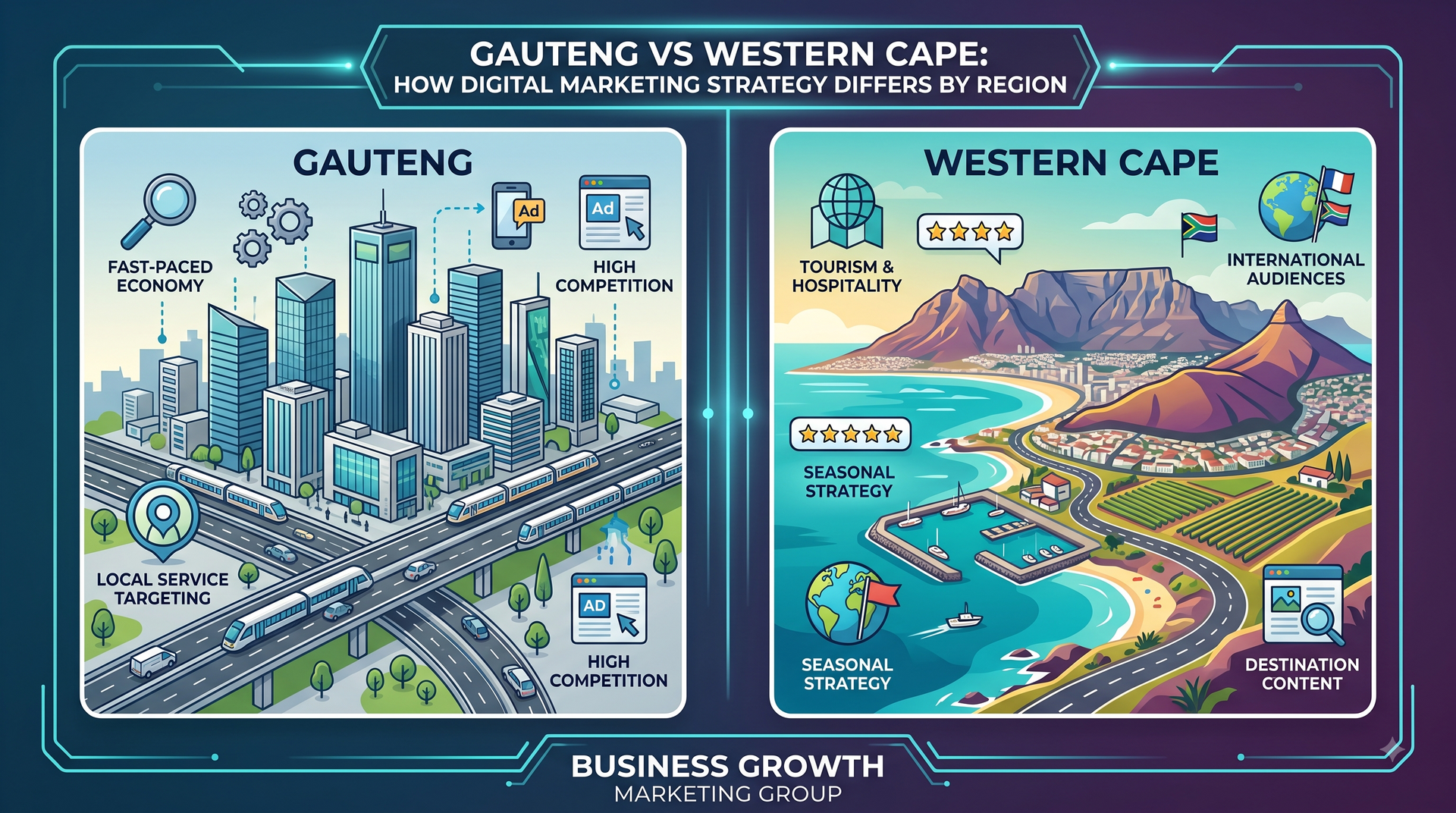
Because Gauteng and the Western Cape have fundamentally different economic engines, a single marketing strategy won't work in both areas. While Gauteng is South Africa's corporate and commuter heartland, the Western Cape leans heavily on tourism, hospitality, and seasonal demand.
These differences shape everything from search behavior to when your ads should even be running. A campaign built around one region's rhythm often feels slightly out of sync the moment you drop it into the other.
Different Economies Indicate Different Customer Behavior
Different economies mean customers search, browse, and buy differently in each region. A Gauteng customer searching for a service is often doing so on a lunch break or a commute, moving fast and expecting a quick answer.
By contrast, a Western Cape customer, especially during peak tourist season, might be planning weeks ahead and comparing options at a slower pace. Neither behavior is wrong. They just call for different marketing responses, and assuming one style of urgency applies everywhere usually backfires in at least one region.
How Gauteng's Business Environment Shapes Marketing Strategy
Gauteng's business environment shapes marketing strategies around speed, convenience, and constant competition. As South Africa's most densely packed commercial region, businesses here are rarely short of nearby competitors, which pushes marketing toward standing out fast rather than standing out eventually.
A business that takes days to respond to an inquiry in Gauteng often loses that customer before it even gets the chance to make its case. This makes fast response times, like quick quote turnarounds or immediate call handling, a genuine competitive advantage rather than a nice-to-have feature.
Gauteng's Commuter Economy and What It Means for Local Ads
Gauteng's commuter economy means a large share of local searches happen on the move, between home, work, and errands. Ads and listings that load slowly, or that bury key details like hours and location, lose customers who simply don't have time to dig for answers.
Instead, fast-loading pages and clear, immediate calls to action matter more here than almost anywhere else in the country. Even a few extra seconds of load time can be the difference between a booked job and a closed tab.
How the Western Cape's Tourism Economy Shapes Marketing Strategy
The Western Cape's tourism economy shapes marketing strategies around seasonality and a wider, more varied audience. Cape Town and the surrounding region see significant swings in demand tied to tourist seasons, which changes both when to advertise and who you are actually advertising to.
For example, a hospitality or tourism-adjacent business in the Western Cape often needs to ramp up spend well ahead of peak season, then scale back during quieter months, instead of running a flat, year-round budget the way a Gauteng service business might. Getting this timing wrong usually means overspending on ads nobody's searching for, or underspending right when demand is at its highest.
Western Cape Businesses Must Target International Audiences Too
Western Cape businesses often need to target international audiences alongside local ones, since tourism brings a genuinely global customer base through the region. This means keyword strategy, ad copy, and even currency display sometimes need to account for visitors researching from overseas, not just residents searching locally.
A restaurant or tour operator in Cape Town, for instance, might get meaningful search traffic from someone still planning their trip from another continent months in advance.
The Difference in Local SEO for Both Regions
Due to variations in underlying search intent and competition levels, local SEO appears differently in each region. What counts as a strong local SEO strategy in one province can feel oddly mismatched in the other, and applying one region's playbook to the other usually leaves real opportunity on the table.
Here is the list of factors that differentiate the local SEO approach for both regions:
| Factor | Gauteng Focus | Western Cape Focus |
|---|---|---|
| Primary Search Intent | Fast, convenience-driven local searches | Mix of local searches and tourist research |
| Competitive Density | Very high, dense commercial areas | High in tourist hubs, lighter elsewhere |
| Review Strategy | Volume and response speed matter most | Detail and international relevance matter more |
| Content Focus | Quick answers, clear service areas | Seasonal guides, broader destination content |
Since a generic, one-size-fits-all approach rarely works, our local SEO strategy falls under this category. If you run a business in Gauteng, Western Cape, or both, we can help you reach your audiences effectively.
Content Strategy Needs a Specific Regional Lens Too
Since the search terms and questions customers use vary between the two provinces, your online content strategy also needs to take a regional perspective. A Gauteng-based content plan might focus heavily on practical, service-specific questions, while a Western Cape content plan often needs to account for seasonal guides, destination-style content, and questions that come from people planning a visit.
Writing one blog post meant to serve both audiences at once usually ends up serving neither particularly well. For example, a guide titled generically around "services in South Africa" reads as vague to a searcher in either region, compared to content that speaks directly to their specific situation.
The Difference in Paid Advertising Strategy Between Regions
Gauteng and the Western Cape have different demand patterns, so budget timing and audience targeting need to match each one separately. Treating both regions the same way, with one fixed schedule and one fixed audience, ignores this difference entirely.
Running identical ad schedules in both regions usually means overspending in one and underspending in the other, quietly wasting budget in ways that don't show up until you compare cost per lead across both. Here is how you must execute your advertising strategy for each region:
| Factor | Gauteng Approach | Western Cape Approach |
|---|---|---|
| Budget pacing | Steady, consistent spend year-round | Weighted heavily toward peak season |
| Audience targeting | Primarily local, commuter-focused | Local plus international visitor targeting |
| Ad messaging | Speed, convenience, immediate availability | Experience, planning ahead, seasonal offers |
| Best-performing times | Weekday commuting hours | Extended hours, including holiday periods |
What Businesses Operating in Both Regions Should Do Differently
Using genuinely separate strategies for each region works better than stretching one campaign across two very different markets. Treating Gauteng and the Western Cape as a single audience usually dilutes what works well in each place, leaving a strategy that is mildly effective everywhere instead of genuinely strong anywhere.
Separate landing pages, separate ad scheduling, and separate keyword research for each region tend to outperform a single combined approach every time. In practice, this usually means:
- A dedicated landing page for each region, not one page trying to cover both
- Ad budgets weighted to match each region's actual demand pattern
- Keyword research done separately, since search phrasing and intent differ
- Review and reputation strategy tailored to each audience's expectations
Google Ads campaigns in particular benefit from this separation, since budget, timing, and messaging can all be tuned independently once the regions are split apart.
Frequently Asked Questions
Does the regional difference apply to every industry, or mainly certain sectors?
It applies more visibly to some sectors than others. Hospitality, tourism, and home services feel the regional split most strongly, while B2B or purely online businesses may see a smaller, though still real, difference in search behavior and timing between the two regions.
Should a business with locations in both regions run separate social media accounts too?
Not necessarily separate accounts, but separate content planning within the same account often works well. Posting schedules, promotions, and even tone can shift slightly to match each region's audience without needing to manage two entirely distinct profiles.
Is it better to run one website with region-specific pages or two separate websites?
One website with clearly separated, region-specific pages is usually the stronger choice. It keeps your domain authority in one place while still letting each region's content speak directly to its own audience.
Match Your Marketing Strategy to Your Market
Gauteng and the Western Cape are not just different cities; they are different economies, customer habits, and competitive landscapes. Treating them as one market usually hurts business performance in both places. Recognizing this early saves a lot of wasted spend down the line.
Business Growth Marketing Group builds its strategy around regional nuance, working with just one client per service area so every plan reflects the market it's built for. Whether you are in Gauteng, the Western Cape, or running in both, get in touch with us and let's build local SEO and Google Ads strategies that actually reflect where your customers are and how they search.
More Recent Blogs