

Why Your Finished Projects Are Your Most Underused Marketing Tool (And How to Fix It)


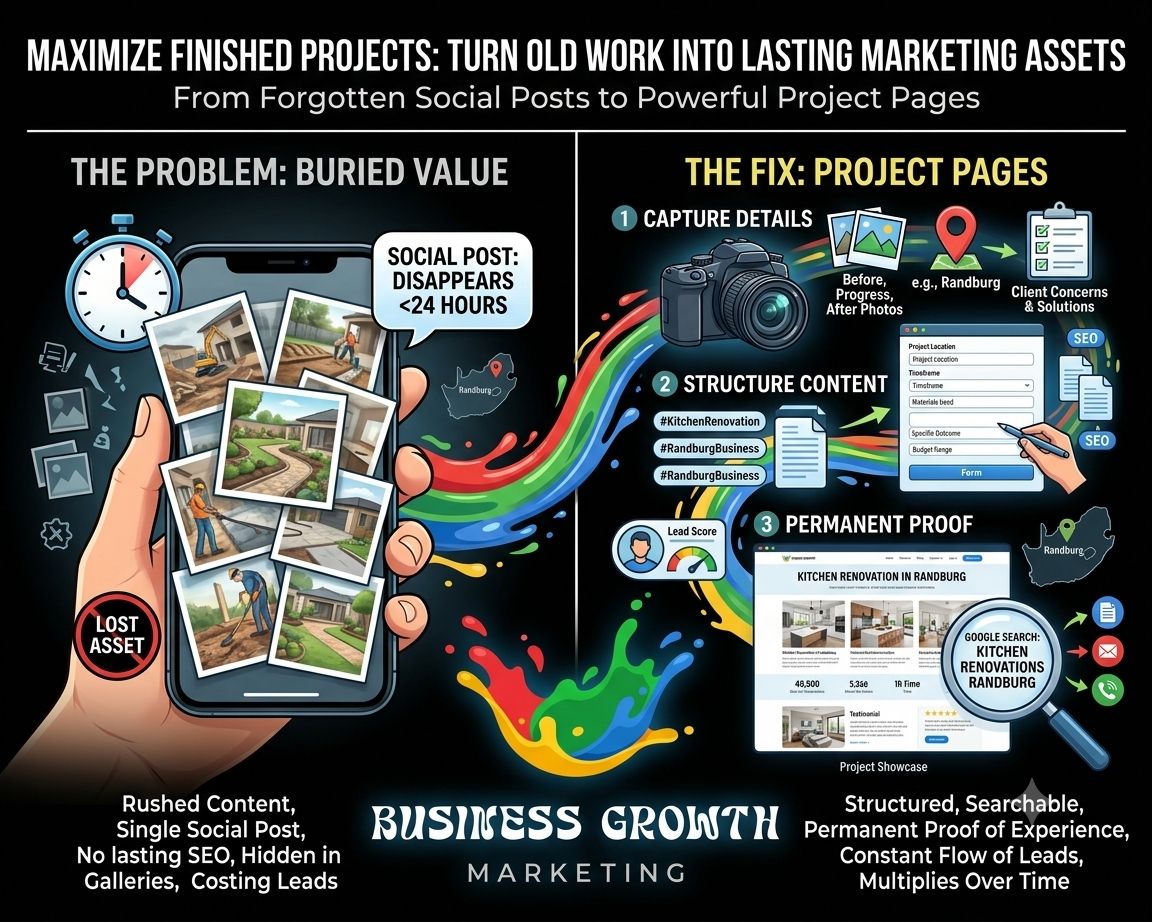
Have your finished projects been disappearing without making a presence? If so, you are not alone. Most businesses finish a great project and let it slip away. A quick photo goes up on Instagram, maybe a caption, or a story, and then it is gone within a day. This makes the actual proof of your skill, the thing that could convince a hesitant customer to book you, sit buried in a phone gallery or an old social media post.
Don't worry. Once you learn the pattern and how modern marketing works, you can easily solve this problem. In this article, we have discussed exactly what to capture about a finished job, how to turn it into content that ranks, and where to put it so it keeps working long after the project ends.
What Usually Happens to Your Best Work After It's Done
If we look at the pattern among most small business owners in South Africa, most finished projects get a single social post and nothing else. A builder finishes a kitchen renovation, posts three photos, and moves straight on to the next job. A landscaper wraps up a garden redesign and does the same thing.
The work was excellent. The marketing value of that work could have driven in more customers, but in reality, it lasted less than 24 hours. This habit exists because capturing content feels like an extra task on top of the actual job.
So, if any documentation is produced, it is rushed and thin. One photo, sometimes blurry, with a caption that says something like "another job completed."
How the Habit of Ignoring Finished Projects Costs You Leads?
A single social post has a short shelf life and barely any searchability. It disappears from feeds within hours, and Google is unable to find it or rank it for anyone searching later.
Contrarily, a webpage dedicated to that same project can keep bringing in traffic for years, showing up whenever someone searches for that exact service in that exact area. For this, all you need to do is start treating the finished projects as content, not an afterthought.
Your Finished Projects Are an SEO Asset, Not Just Proof of Skill
The first thing you need to do is introduce the “Project Pages" section to your official website. These pages will not only serve as your proof of experience but also help your website rank. It is because they give Google something social posts never do: specific, structured, permanent proof of experience.
Project Pages Support Real Experience Signals
A dedicated page that describes a project, with real photos, details, and a realistic outcome, is exactly the kind of content that signals genuine experience. It differs from the generic "About Us" page found on nearly every website that claims years of expertise without any supporting evidence.
Remember that Google algorithms cannot verify a claim. They can only recognize a specific account of real work. Search engines are getting better at distinguishing between a page that describes real work and one written to sound impressive.
Competitors Can't Easily Copy Original Content
It is obvious that generic service pages are easy to copy. For example, if you are in the home remodeling business, every competitor in your industry has a near-identical "Kitchen Renovations" page with similar stock images.
However, nobody can copy your finished projects because the content is entirely yours. That makes finished projects the best SEO asset a small business has. The next step is making sure you actually capture that asset while it is happening, not after the moment has passed.
How to Capture Content Before a Project Ends
In order to capture the right content, you need to plan it before the job even begins. A few extra minutes during the project saves you from having nothing usable once it is finished. Build the following steps into your process:
- Before photos, taken in good light, showing the starting point of the project clearly
- Progress photos at two or three key stages, not just the final result
- After photos from the same angles as the before shots, for a clean comparison
- A short note on the specific problem the client had and how your team solved it
- Any unusual challenges you solved along the way, written down while they are fresh
Details That Make a Project Page Useful
The details that turn a random project into useful content are the ones that both a search engine and a real customer care about. That means the location, the service performed, the timeframe, and the specific outcome.
Let’s see an example:
"We renovated a kitchen." This tells nobody anything specific.
"We renovated a 15-year-old kitchen in Randburg over three weeks, replacing outdated cabinetry and adding an island." This tells both Google and your next customer exactly what you did.
Being precise about numbers can be useful too. They help the page rank for more specific searches, and they help a hesitant customer picture their own project more clearly. Include details like:
- The size of the space, room, or area involved
- The budget range, if you're comfortable sharing it
- The exact materials or products used
How to Turn a Project Into a Web Page That Actually Ranks
Turning a finished project into a ranking page requires more than just uploading photos. The difference between a gallery and a genuine project page lies in structure, and structure is what both search engines and readers respond to.
Read this table to establish a better understanding of how to utilize the captured content:
| Format | What It Achieves | What It Misses |
|---|---|---|
| Single social media post | Quick engagement with existing followers | No lasting SEO value. Disappears within a day |
| Photo gallery with no text | Shows the work visually | Google algorithms get nothing to read or rank. |
| Full project page with description and photos | Ranks for specific services and areas. Builds trust. | Takes more time to show results properly |
Avoid Vague Language That Does Not Describe the Actual Work
Avoid vague, sales-heavy language that does not actually describe the project. Phrases like "outstanding results" or "exceptional craftsmanship" say nothing concrete.
Instead, stick to real details like:
- What was the client’s concern,
- What services did your team provide,
- How long did it take,
- and what the client genuinely wanted was resolved.
A well-written page is only useful if it lives somewhere people and Google can actually find it.
How Often You Should Publish New Projects
Publishing consistency matters more than documenting every single job. One properly written project page a month builds a stronger showcase over a year than a rushed page for every job that comes through.
| Business Type | Suggested Frequency | Why |
|---|---|---|
| High Project Volume (trades, contractors) | One or two strong pages per month | Enough variety without diluting quality |
| Lower Project Volume (consultants, specialists) | One page per completed major project | Each project carries more individual weight. |
| Seasonal businesses | Cluster publishing around peak season | Matches search demand timing |
Frequently Asked Questions
What should be the length of a project page?
Although there is no fixed word count, there should be enough detail to explain the problem, the approach, and the outcome. It usually falls between 300 and 600 words. Adding more just to reach a longer length tends to weaken it rather than help it.
Can I use projects from years ago, or does it have to be recent work?
Older projects still work, especially if they were strong examples of your skill. However, you should try to mix in recent ones. A project page that stopped three years ago quietly signals that the business has slowed down.
Do project pages remove the need for testimonials?
No, they work together rather than replacing each other. A project page shows what you did. A testimonial shows how the client felt about it. Pairing them on the same page is often the strongest combination.
Let Your Completed Projects Sell Themselves
Every finished project is proof that your business can be trusted with the next one. Right now, your proofs are probably scattered across old social media posts or sitting unused on a phone. Turning it into structured, searchable content on your own site means it keeps working for you long after the job is done, bringing in new leads instead of fading out of a feed.
If putting this system together feels like one more thing on an already full plate, Business Growth Marketing Group's Project Showcases and Blogs service handles it for you. Get in touch with us, and let's turn your finished work into your strongest marketing asset.
More Recent Blogs